THE MAGNI DIFFERENCE
By Greg Gremminger
Overview
We are proud that Magni gyros have been a primary influence on the improved safety of our sport over the last couple decades. The safest and most popular gyroplanes around the world are either Magni gyros, or the number of aerodynamic clones of Magni gyros, that have essentially eliminated the traditional safety issues of Buntovers and Pilot Induced Oscillations. However, there are other less obvious, but still important, safety and reliability issues ‐ other than simply the Magni “Big Tail Way Back” aerodynamic solution adopted by the Magni “clones.”
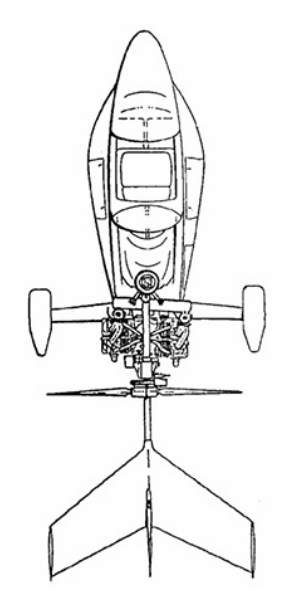
Although the Magni “Big Tail Way Back” configuration is now popularly emulated by numbers of Magni “clones,” some explanation of more hidden attributes of this configuration are worth discussing. The large horizontal stabilizer, mounted far back on the tail keel is an excellent way to afford “Dynamic Pitch Damping” to any aircraft. The big secret with the big tail is that the further aft it is mounted the much, much more effective it is as a DYNAMIC pitch damper. It turns out in gyros, as in all aircraft, the secret to positive, precise and stabile control is the DYNAMIC damping afforded to the airframe by the horizontal stabilizer. This is the feature many gyro designers are now adopting – but there appears to be little appreciation or understanding of just how this is an advantage over just a purely large tail.
A large tail is a STATIC stability advantage certainly – most people understand this as a “balance beam” of the horizontal stabilizer statically balancing the destabilizing surfaces forward of the CG. This is all true in the simple determination of STATIC stability. But, as it turns out, strong DYNAMIC pitch damping is what even more so effects precise handling while also complementing or enhancing the aircraft’s STATIC stability. In fact, strong DYNAMIC pitch damping can actually make a presumed statically unstable aircraft fly with strong static stability. This may seem implausible, and the technical reasons are difficult to understand, but there are numbers of examples that show this to be true.
A simple static analysis of the sum of moments is a very incomplete analysis of the stability and control performance of an aircraft. For instance, many designers, considering STATIC analysis only, strive for Centerline Propeller Thrustline (CLT), or Low Propeller ThrustLine (LTL) to achieve flight static pitch stability as determined by the sum of static forces acting about the Center of gravity (CG). Actually, a purely CLT gyro, or any aircraft, might not be statically stable anyway. A LTL configuration would actually be statically stable in a paper sum of moments static analysis – the CG would be forward of the Rotor Lift Vector (RTV) – but this would only be when the propeller is developing thrust to hold the CG forward of the RTV in flight. (When power/thrust is minimal, this LTL “Thrust Enhancement” of static stability is non‐existent. When static flight stability depends on propeller thrust, the gyro is not necessarily statically stable or as statically stable, and the control handling may require more pilot proficiency in the less stable aircraft with power reduced.
True static flight pitch stability, independent of propeller thrust or even airspeed, can be provided by the horizontal stabilizer. The horizontal stabilizer can be mounted at a negative incidence angle to force the CG into its statically stable location forward of the RTV. This is one way to balance other static destabilizing airframe moments, such as a high Propeller Thrustline (HTL). But, the down‐loaded horizontal stabilizer requires more rotor (or wing) lift to compensate – requiring more power for flight with the down‐loaded horizontal stabilizer – less efficient flight. This effect is minimized when the horizontal stabilizer is mounted on a long tail boom – more nose‐up airframe moment with less down‐ load from the stabilizer.
The Magni secret, and the one copied by the Magni “clones,” is that the horizontal stabilizer is not counted on to provide a static stabilizing nose‐up moment on the airframe. The horizontal stabilizer on the Magni, and on its “clones,” is absolutely level to the airstream (when properly loaded). This does not provide even enough nose‐up moment to balance the HTL statically destabilizing moment from the high mounted engine on this configuration. The large horizontal stabilizer, mounted far aft of the CG, provides very strong DYNAMIC pitch damping to the airframe that effectively provides the necessary and strong static flight stability of this configuration. The Magni (and “clones”) “Big Tail Way Back” provides the DYNAMIC pitch damping that makes the gyro fly STATICALLY pitch stable – even though a simple Sum of Static Moments analysis would suggest otherwise. As it turns out, the “Way Back” part of “Big Tail Way Back” is the most important part towards the desirable strong DYNAMIC pitch damping.
Numerous examples of HTL gyroplanes, that some would suggest are susceptible to buntovers and pilot induced oscillations, are the new generation of gyroplanes that incorporate the “Big Tail Way Back” configuration. Magni gyros and its “clones” are perfect examples of this. This configuration is very certainly significantly HTL. Conventional “wisdom,” predominate in the gyro culture, suggests that these would be an accident waiting to happen – that they would be STATICALLY unstable and would therefore be very difficult to fly safely. However, these “Big Tail Way Back” configurations are shown by standard accepted static stability flight testing methods to be strongly statically pitch stable. Upon a disturbance from pitch attitude or airspeed, the aircraft inherently quickly returns to the original trimmed condition without oscillation or over‐shoot, and without pilot input (both with the stick free and the stick fixed).
This is STATIC flight pitch stability. The strong DYNAMIC pitch damping causes this aircraft to return to its initial static trimmed condition with minimal oscillations – actually no oscillations – that might induce pilot over control (Pilot Induced Oscillations).
Besides professional British Section T and other flight tests demonstrating the static pitch stability of this configuration, deployed experience with large numbers of Magni gyros and its “clones” demonstrate no tendencies toward buntovers and Pilot Induced Oscillations – the characteristics a purely but incomplete static sum of moments analysis might suggest. There are no reported incidences of Pilot Induced Oscillations or Power Push‐Overs or buntovers in these “Big Tail Way Back” gyroplane configurations.
Even more anecdotal evidence of the stable and precise control afforded by the strong DYNAMIC damping is the turbulence penetration and apparent safety of this configuration reported by experienced and less experienced gyro pilots in strong winds. More anecdotal evidence of these benefits come from the ease of learning to fly such configuration gyroplanes. There is none of the traditional “jab and counter jab” technique required on the traditional unstable gyrocopters of the past – control is precise and accurate – move the cyclic stick and the gyro obediently flies to that attitude with no oscillations or over‐shoot that less stable gyrocopters might require. The aircraft controls exactly like all airplanes are intended to – except that it is much less susceptible to turbulence disturbances and still has all the beneficial attributes of a gyroplane (no stall, slow and fast flight, short and slow landings, etc.)
One last point before moving on to some real Magni Differences: This “Big Tail Way Back” dynamic damping benefit is not confined to only the low seater Magni and “clone” configuration. That applies to almost any configuration gyro that has a “Big Tail Way Back”. The point is though, with the incorporation of a strong dynamic damping “Big Tail Way Back”, it is no longer necessary to try to provide static stability with a cabin mounted very high above the ground to achieve CLT or LTL. Gyro configurations that depend on propeller thrust to enhance static stability do not assure static stability and familiar/safe handling in all flight situations. When power is reduced or quits, the stability enhancement disappears. But, more importantly at higher airspeeds where gyros without good dynamic damping surfaces become less stable, the prop thrust reduces naturally at higher airspeeds – just where the enhanced static stability is most necessary! Using a “Big Tail Way Back” for strong dynamic pitch damping, that effect and Static stability actually improves at higher airspeeds.
We are certainly very proud that several decades of Magni safe operation has influenced the gyroplane community and designers to incorporate such an important technology as a “Big Tail Way Back.” Actually, that has never been a secret that Magni demonstrates. The Autogyros of the 20’s and 30’s did the same thing with their tractor configurations and long tails. And, almost all airplanes, from Curtiss and Bleriot, to today, employ the “Tail Way Back” configuration to achieve the control characteristics that have proven to be so desirable and safe.
Having said all of the above, I now want to expose to you some Magni differences that the “clones” have not fully appreciated or successfully emulated.