
How to Save Gyro Pilot Lives - Stop Pilot Error
Part 1
by Greg Gremminger
Let’s face facts! There are too many needless fatal accidents in gyros! It is time for all of us to do something about it – for our own safe gyro flying and for that of our friends. It has been just too easy to blame a certain type of gyro, or a deficiency in training or a lack of training! These are certainly major contributors to many or most fatal accidents, but it has also been just too easy to blame these fatalities on “Pilot Error” – with the concession that we just can’t do anything about making bad decisions. It is too easy to just say we “can’t fix stupid!”
We might not be able to “fix stupid,” but we can do a lot about reducing bad decisions. “Pilot error” is often a catch-all phrase that implies an inherent human deficiency that can’t be corrected. Not true! Pilots are human, and can learn, we can plan and we can all make better decisions. With proper training, improved knowledge, and a few tools to overcome some human weaknesses, and by learning from past mistakes, we can make better decisions and we can help other pilots make better decisions.
If you have studied for a Pilot’s rating in recent years, you have been exposed to “Aviation Decision Making” (ADM). The FAA has been placing great emphasis on providing the knowledge and tools to help people make better decisions, recognize and avoid risks, and understand our human traits that can create hazardous attitudes that lead to mistakes and accidents.
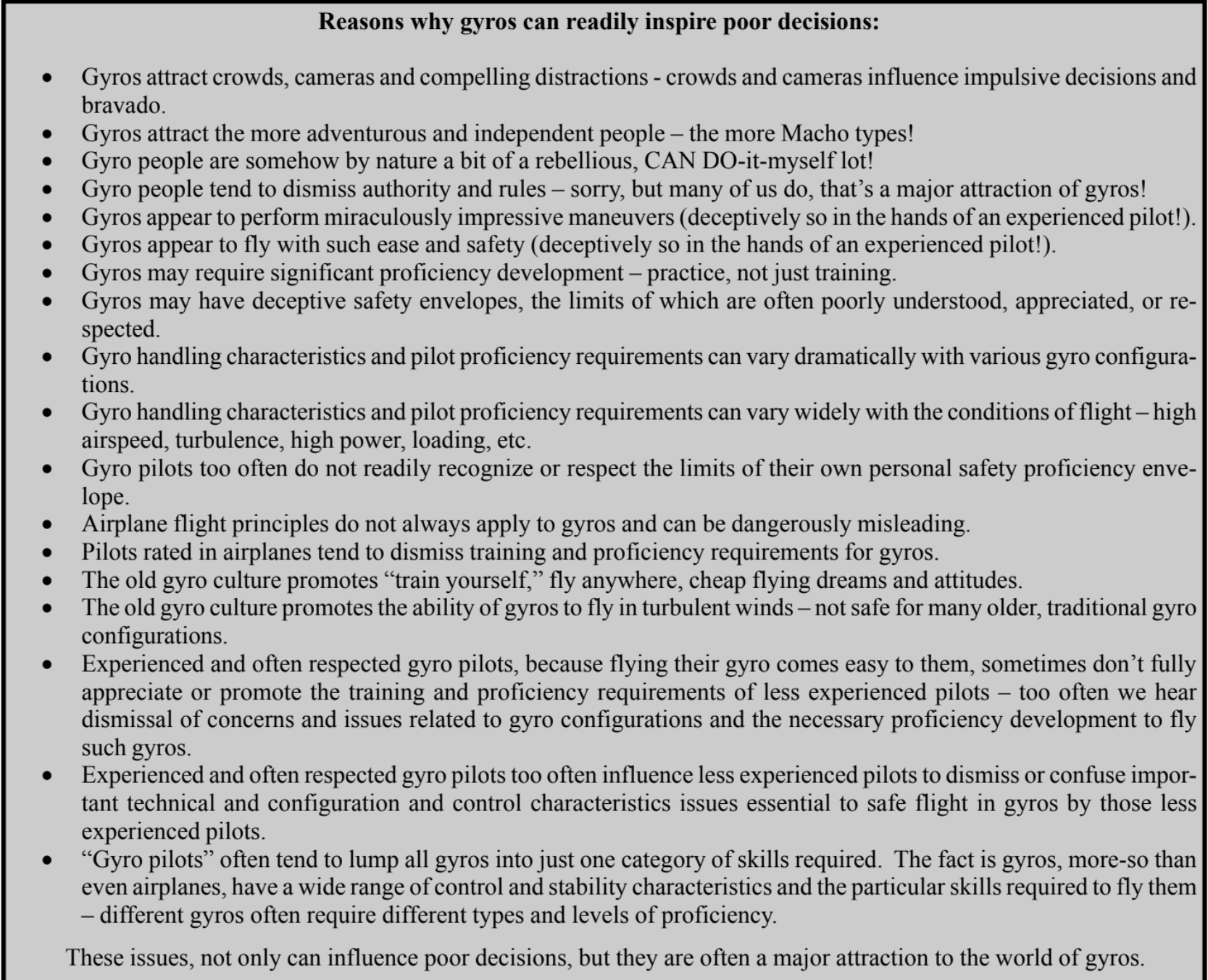
Listen up - this is an even MUCH MORE IMPORTANT ISSUE FOR GYRO PILOTS. More so than most other types of aircraft, and due to the many unique issues and attractions of gyros, gyros can easily create and invite hazardous attitudes, situations and misleading perceptions. Here are some specific reasons why gyros can readily inspire poor decisions:
ADM is an element of ground training that has been promoted and required by the FAA for only five or six years now. The concept is similar to safety programs developed in heavy industries to improve safety awareness and was derived from successful Crew Management Programs of the airlines. The premise is that through knowledge of the issues and potential hazards and forming habits of making plans, identifying risks and forming options, individuals can avoid surprises that lead to accidents.
The program presents human traits and deficiencies that are commonly involved in making poor decisions and how to recognize the associated “Red Flags.” To study the full aspects of ADM, I strongly recommend that you obtain a copy of the FAA’s Advisory Circular on Aviation Decision Making (AC-60-22)
Available on the WEB at the FAA Advisory Circular search page: http://www.airweb.faa.gov/Regulatory_and_Guidance_Library/rgAdvisoryCircular.nsf
Also, a very good presentation of ADM is included in the FAA’s Rotorcraft Flying Handbook (FAA-H-8083-21) available through the PRA office or most aviation materials suppliers. (The Rotorcraft Flying Handbook is a “must- own” for anyone flying gyros anyway.)
[In later posts] I would like to discuss several ADM concepts and techniques that may be especially helpful to gyro pilots and students.
