
H-Curve for gyroplanes
By Greg Gremminger
This article is an update to the original article on the subject we had published in Rotorcraft several years ago. The subject is an important safety issue for gyroplane fliers to understand and respect. Recent events suggest reasons to review this subject again. But, importantly also, this article is to point out additional significant and possibly inadequately understood “aggravating conditions” within the Height Velocity (H/V) curve that gyro pilots should understand and appreciate.
“Deadman’s Zone!” - is an ominously descriptive term for the Height Velocity curve for rotorcraft. Helicopter pilots are drilled on this issue and the limitations it presents for helicopter operations. Most people think that helicopters can go straight up from the ground and straight down to a landing. They can if the engine continues to provide power, but you won’t catch a lot of helicopter pilots doing this. Ever notice how most helicopters takeoff at hover height as they accelerate along the ground before climbing out – very similar to what gyroplanes do as well. They do this to avoid “Deadman’s Zone” in the event that the engine might falter or quit.
There may be a false presumption that the H/V curve is only important for helicopters, not for gyroplanes. The H/V curve IS important to gyroplanes, and for the same reason, engine falter or failure, as it is for helicopters.
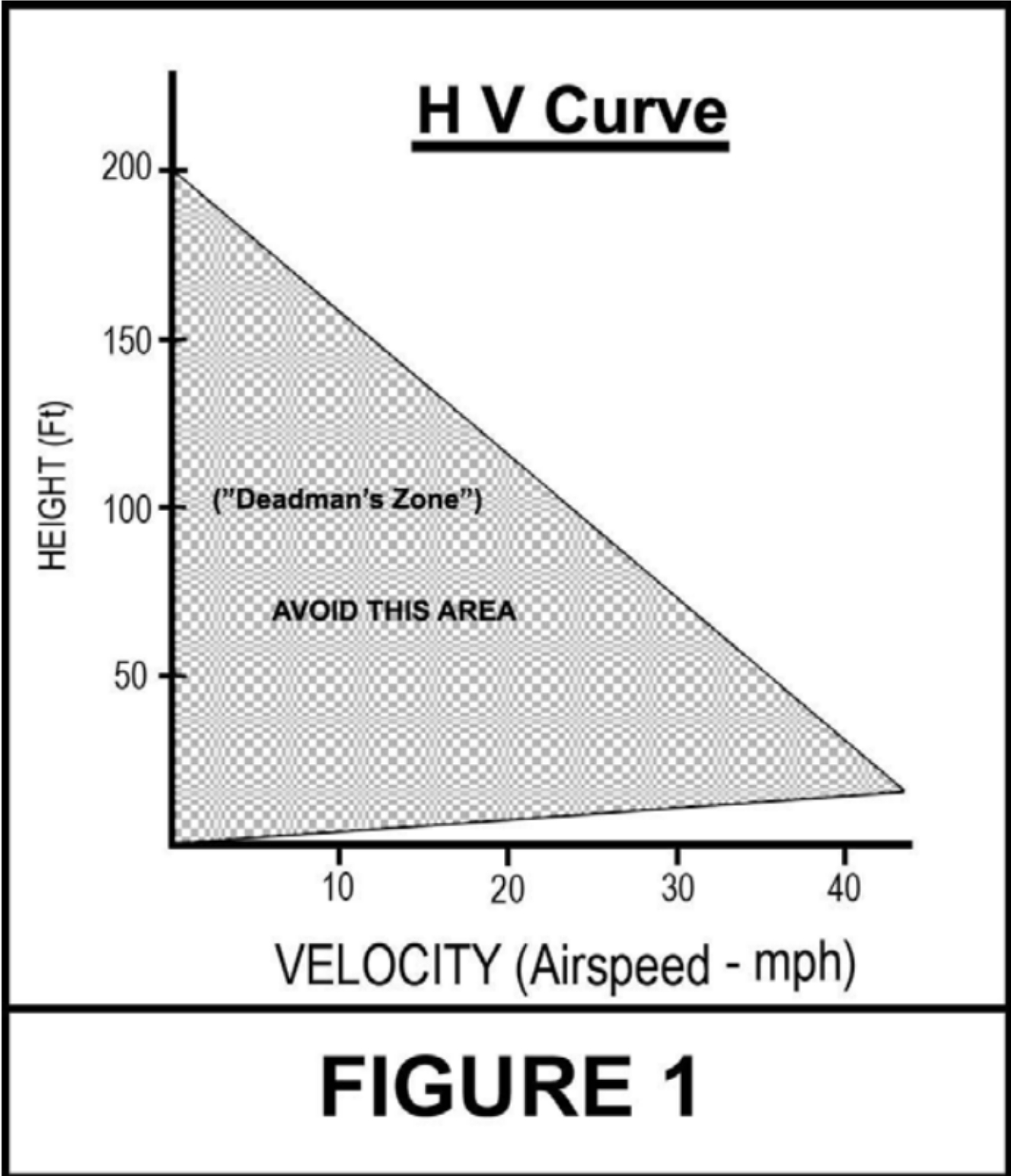
What is the H/V curve and why is it important for rotorcraft – all rotorcraft? The H/V curve is an actual graph (Figure 1) that depicts the minimum combination of height potential energy and speed potential energy required to recover rotor RPM and airspeed to make a safe landing IF the engine is not available – if the engine FALTERS or QUITS! Or more accurately, it depicts the area of flight, combination of height and velocity, that should be avoided. The H/V curve mostly applies if the engine quits or falters. You might not ever get in trouble flying within “Deadman’s Zone,” but should we really take a chance with any engine?
When you might see a helicopter takeoff straight up or land straight down, understand they are betting their lives on the engine(s) not quitting when they are within the H/V curve – and they are in circumstances that absolutely require it! Some pilots have a pretty good bet IF their helicopter happens to have two engines or highly reliable turbine engines! But, if there is just one engine, and that engine might possibly quit or even falter momentarily on takeoff or landing, you will see most pilots maintain or attain adequate airspeed at lower heights close to the ground – below the H/V curve – on both takeoffs and landings! Pilot skill is also an important element in the risk equation pilotsshould be aware of if they are tempted to fly within “Deadman’s Zone!”
In some helicopter applications and circumstances, you might see the pilot actually climb straight up or set down vertically in a clearing – but that is most often with helicopters that have reliable twin turbine engines – such as military applications.
H/V curves also apply to gyroplanes – they have “Deadman’s Zones” also! All rotorcraft require a sufficient amount of rotor RPM and airspeed to be able to raise the nose and make a safe “deadstick” landing. If the engine is not available to provide some of this landing energy, the rotorcraft – including gyroplane – has only its potential energies of height and velocity to use up for the required energy for a safe landing. Height is a form of energy – “potential” energy because you can convert height above the ground into landing energy of rotor RPM and airspeed. Airspeed is also a form of potential energy, and if there isn’t enough airspeed for a safe landing, the pilot needs to increase airspeed by trading some height for additional velocity, or applying engine power. This is the rub! If the engine is not available, all the landing energy must come from the existing airspeed and any extra height the pilot can convert into more airspeed.
All rotorcraft have different H/V curves. Figure 1 is a typical H/V curve for a light single-place gyroplane – but yours may be different. Heavier, and the curve probably starts at a higher height and requires a higher airspeed close to the ground. Lighter single seat gyroplanes might start as low as 150 ft., and maybe require only as little as 35 mph close to the ground – in order to make a safe landing if the engine quits there! Helicopters tend to have H/V curves that start about twice the height above the ground as a comparable gyroplane. A typical light helicopter might have its H/V curve start at 700 – 900 ft. above the ground. Because the H/V curve of a gyroplane tends to be somewhat smaller than a helicopter, some people might be tempted to ignore the “Deadman’s Zone” for gyroplanes – DON’T! If your gyroplane engine quits or even just falters momentarily within the prohibited area of your particular H/V curve, you might have a worse day than just an emergency landing!
How to use the H/V curve – referring to Figure 1:
If you are at zero mph, in a vertical descent, you must be at least 200 ft. above the ground in order to be able to lower the nose and make a safe landing if the engine suddenly quit or was not available. The closer you are to penetrating this H/V curve, the more skill it requires to trade the height you do have for adequate rotor RPM and airspeed to make a safe landing
If you are about 100 ft. above the ground at approximately 25 mph, you have just barely enough speed and height energy in total to attain adequate landing rotor RPM and airspeed for a safe landing – if you do it right!
If you are at 100 ft. and less than about 25 mph, there is not enough energy to make a safe landing – no matter how good you are!
If you are flying at 30 mph at 25 ft., you don’t have enough
energy if the engine quits!
If you are flying low, close to the ground, under the lower “ledge” of the H/V curve, you probably can make a safe landing – with adequate proficiency!

How can you get into trouble with the H/V curve?
Figure 2 – Vertical Descent:
Remember it mostly only matters if your engine is not available, or quits while you are within the H/V curve. The Vertical descent scenario: This is where we see a lot of people venturing, probably unaware of the risk! It looks spectacular, really impresses the uninformed gyro crowd, but is highly dangerous! Descending at near zero airspeed to just a few feet above the ground, and then applying power to fly out in a spectacular power dive to ground level! Opening the throttle quickly on many engines, after a period of idle power, is just where most engines are likely to sputter, or cough – or die! If it does, you just made a pancake of you and your gyro! Go up to 1000 ft. or so, establish a vertical descent with engine at idle, and, at a noted altitude, lower the nose to attain enough airspeed to simulate a flare to landing – see how much altitude you really need – that, plus some safety margin, is the top of your H/V curve!
Figure 3 – Show off zoom takeoff:
We see this a lot also. A major reason we teach people to accelerate in ground effect to their best rate of climb airspeed before starting to climb is to avoid climbing into “Deadman’s Zone.” This “hot dog” takeoff looks spectacular and wows the crowd – at least the unaware crowd! BUT:

Allowing your gyro to climb into “Dead-man’s Zone” before you attain adequate airspeed invites injury or worse, even if your engine just coughs a bit! In a steep and slow climbout, the nose is high. If the engine coughs or quits, the aircraft will slow immediately and quickly. Pilot reaction would and should be to quickly lower the nose to maintain and restore airspeed before losing more airspeed in the climb! But, this is a particular problem for autorotating rotors – such as on our gyroplanes! The steep, “hanging on the prop” or riding the momentum of a zoom has the rotor slower than normal already. But, the act of pushing the nose lower further spikes a lower G-Load on the rotor, immediately slowing the rotor RPM even more. Severe or rapid nose down pitch, as might be excited upon engine failure in a steep, nose-up climb, can radically slow the rotor. But, then suddenly, as the airframe attitude gets to level or nose lower, the rotor suddenly has full G-load presented to it – with a slow rotor! This can be essentially like “over-running” the rotor on takeoff – the air forced through the rotor is more than the rotor can accept at that lower rotor RPM, and the rotor does not quickly restore its RPM. The result is a rather surprising rapid altitude loss – even if the pilot puts the nose down steeply to try to restore airspeed. In fact, the act of lowering the nose too quickly too far at any time, can immediately lower rotor RPM and the subsequent re-loading of the rotor to full airflow and G-Load might not allow quick recovery of the rotor RPM – basically “over-running” the rotor in flight! In the extreme, the rotor could actually violently “flap” - hit the teeter stops!
Try this at altitude also: In a power off vertical descent, near zero airspeed, lower the nose and see what the rotor RPM does and how much altitude it requires to recover. Repeat this with gradually more rapid lowering of the nose to steeper nose-down attitudes. You will discover that, when you too steeply lower the nose too rapidly – to quickly recover airspeed - you may restore airspeed quickly, but the rotor RPM lags behind and the gyro continues to lose altitude, dropping like a rock until the rotor RPM catches up. In this demonstration, notice that a more gradual lowering of the nose actually results in less altitude loss to attain adequate rotor and airspeed energy to be able to make a safe landing flare. But, in a steep and slow climbout, close to the ground, if the engine quits, not many pilots should or would gradually lower the nose! To be able to raise the nose in a landing flare requires more than just adequate airspeed – it also requires adequate rotor RPM – or you are likely to strike the ground in a nose-down attitude – surprisingly not able to raise the nose for a flare - not often survivable! Engines don’t quit often, but right after takeoff at full power is a highly likely occasion for engines to quit. I suggest you religiously avoid flying within the H/V curve on all takeoffs – just not worth the risk of having a really bad day!
Figure 4 – behind the power curve:
There may be little wrong (in most gyros) with flying “behind the power curve” – nose up, lots of power, hanging somewhat on the prop – at adequate height to recover if the engine quits! Nose high, hanging on the prop, itself lowers the Rotor RPM because the prop is carrying some of the weight of the gyro. If the engine were to quit, just as in Figure 3 above, the rapid lowering of the nose will further lower the Rotor RPM – with the same rapid altitude loss discussed above – maybe more! If you are practicing or showing off for the crowd – with your fantastic skills to fly very slow “behind the power curve,” please do so either below or above the H/V curve – so you don’t personally add even more credence to the “Deadman’s Zone” description.
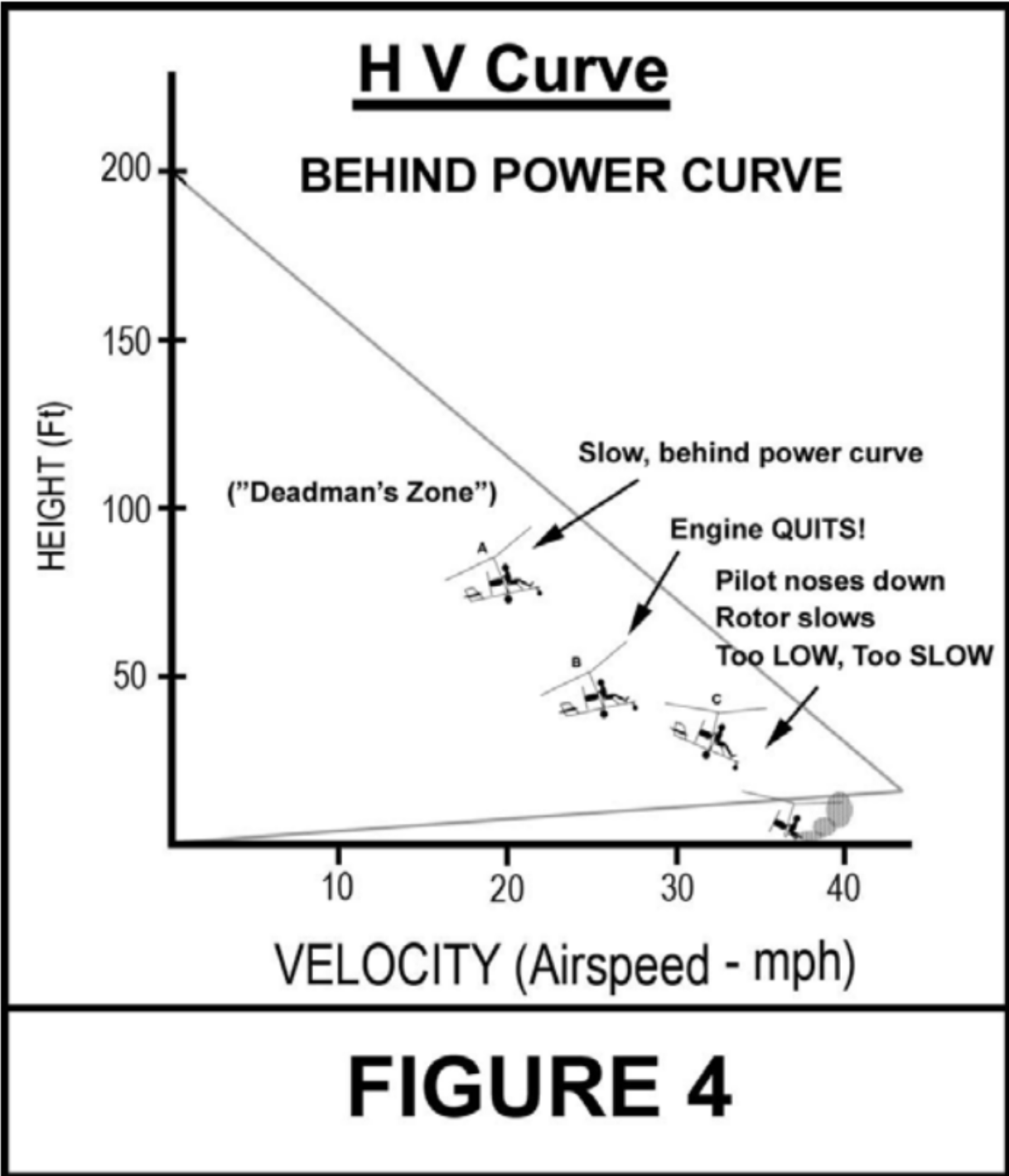
Above I mentioned several times that the H/V curve applies “mostly” if the engine quits or is not available. Engines quitting is the origin of the H/V curve. However, the situations depicted in Figures 3 and 4, recovery from a steep nose-high altitude at slow speed, does not really require the engine to quit. If the engine just sputters, or falters momentarily, the pilot is likely to be startled into a sudden nose-down input, the scenarios of reduced and slow to recover rotor RPM and rapid altitude loss – “dropping like a rock” can be initiated – just from the rapid forward stick motion! So, the engine doesn’t really have to QUIT to cause problems if you are flying within the H/V curve – unable to recover before striking the ground.
How do I know what my H/V curve is? Hopefully your gyroplane manufacturer has determined and provided the H/V Diagram in your aircraft flight manual – all certificated aircraft (Standard or Experimental) are required to have a Flight Manual or Pilot’s Operating Handbook (POH). If you don’t have a curve provided to you, you can go up to a safe altitude and descend at zero airspeed and see how much altitude it takes you to recover rotor RPM and airspeed for a good simulated landing flare at altitude. Add at least 100 ft. to this altitude loss - this will be the top peak of your H/V curve. The highest airspeed tip of the curve might range from 35 mph for a light single-place gyro up to 50 mph for heavier gyroplanes – but, for this, your normal landing sequence would be a good representation of the lower “ledge” of your curve. When you make a normal deadstick landing, note your height above the ground and airspeed just after raising the nose to start your flare on a normal deadstick landing. This is the right “tip” of your H/V curve. Add a little airspeed for a conservative safety margin to account for not being perfect in a sudden surprise engine failure, and you have pretty well defined your H/V curve. Your H/V curve should allow for a delay in pilot reaction due to what the FAA calls the “startle factor.”
Aggravating conditions:
Another factor should be recognized and respected in your reaction to a sudden engine stoppage, or even a short burp of engine power where you, in your “startle” reaction might react with a rapid lowering of the nose. As stressed above, lowering the nose too rapidly will reduce the rotor RPM – perhaps dramatically. Certainly, from a nose high attitude, it is imperative to lower the nose quickly to avoid rapid loss of airspeed upon power loss. But then, the impulse is to continue rapidly lowering the nose to regain best glide speed. And, some gyroplane configurations may actually suddenly and rapidly lower the nose automatically upon an engine stoppage due to sudden loss of propeller thrustline below the Center of Gravity, or from sudden reduced airflow on the Horizontal Stabilizer. Too rapid lowering of the nose, with the accompanying significant loss or rotor RPM, will dramatically require more altitude loss than anticipated before the rotor regains effective RPM again. It is certainly a trade-off in how quickly you should lower or allow the nose in any case. Too slowly, and you lose airspeed and time to attain best rate of glide airspeed. Too rapidly, and you lose perhaps even more altitude before the rotor can recover RPM.
Another factor to be considered in all this, is the flight conditions that might have your rotor at a lower RPM already – before the engine might quit! Climbing at a steep nose-high attitude, or “hanging on the prop,” as discussed above, lowers the rotor RPM because the prop is carrying some of the weight of the gyro. Also, rotor RPM, with light loading, as with flying single place in a 2-place gyro, will be lower to start with. And, cooler weather or lower Density Altitudes will also present initially lower rotor RPM. If the initial rotor RPM is significantly lower than normal flight condition, it is already closer to in-flight “flapping” – lower rotor RPM requires more teeter range for the same airspeed no matter what the temperature or loading is. So, with any of these factors in play, it is even more important to avoid the nose-high attitudes of a steep climb, or “hanging on the prop” thrills. Especially with a light rotor, and initially low rotor RPM anyway, it is not impossible for a too rapidly lowering nose to reduce rotor RPM to a range where it cannot recover before severe in-flight “flapping” – hitting the teeter stops or worse.
If the rotor RPM cannot recover before arriving at the ground, the pilot may not be able to raise the nose for a flare before ground impact. It’s important that gyro pilots understand these aggravating conditions, give the H/V curve plenty of respect, and practice recovery from these situations to be more prepared if/when it happens for real. It can be a very bad day, if, during recovery from engine failure, you find a sudden unexpected rapid altitude loss, and the inability to regain landing speed or raise the nose when you arrive at the ground. In NTSB gyroplane accident reports, we too often see the accident cause as “pilot failed to maintain rotor RPM.” This might also be the result of “pilot failed to respect the H/V curve!”
I am sure you remember from your initial gyroplane flight training that the instructor had always emphasized to never “jab the stick forward”. This was traditionally part of the effort to avoid buntovers or Power Push Overs (PPO) in those older less stable gyros that might be prone to such fatal events. That has always been important and valuable advice. In less stable gyros, “jabbing” the stick forward, lowering the nose too rapidly, can initiate a progressive unrecoverable buntover or PPO. That possible buntover is the result of significant rotor RPM drop upon a forward stick “jab”; and contributing effects of other unstable gyro characteristics that that gyro might also have. In more statically stable gyroplanes, the same reduction of rotor RPM still occurs with the same forward stick “jab”. But, due to the improved stability of the gyroplane otherwise, the feared progressive buntover is much less likely. The rotor RPM drop is still there, but the stable aerodynamics blunts the full progression into a true buntover or PPO. This does not mean that that same, too rapid forward “jab” might not result in severe rotor RPM drop or even in-flight blade “flapping” – rotor hitting its teeter stops or worse. In this new age of more stable gyroplanes, that are much less susceptible to buntovers or PPO (or Pilot Induced Oscillations - PIO), the traditional instructor advice, while possibly less important in avoidance of buntovers, is still important to avoid surprising loss of rotor RPM – especially in the event of engine loss in conditions of attitude, speed, temperature, loading, height or velocity that make it impossible to recover to a safe landing.
The FAA suggests that pilots should practice sudden engine failures frequently to temper and tune their “startle” reactions to the best practiced response for their aircraft. This is best done if you would have an instructor “pull the power” often and unexpectedly numerous times regularly. But, certainly, gyroplane pilots should practice recovery from sudden power losses, to determine the rate of lowering the nose that results in minimum altitude loss – to determine what altitude loss is required to regain adequate rotor RPM and airspeed to make a safe flare for landing. Of course, do this at altitude, and pay attention to the amount of unexpected altitude loss occurring with different rates of lowering the nose upon power cut.
In summary, please review and respect your H/V curve, or a very conservative version of one. On my heavier two-place gyroplane, the H/V curve starts at 500 ft. to allow for the “startle factor” delay and the possibility that the engine could quit in a nose high pitch attitude where some rotor RPM will certainly be lost in even a measured lowering of the nose to gain rotor RPM and airspeed. It is important to be very familiar with your particular machine to know just what rate to lower the nose is optimum for minimum altitude recovery for landing, and avoid rotor RPM drops that might threaten an in-flight blade “flap.” Allowing some conservative safety margin minimizes the necessity of doing everything perfectly in a surprise situation! You certainly do not want to discover why the H/V curve is important the first time your engine sputters or quits or won’t respond to throttle. Take notice of flight conditions that result in lower rotor RPMs than you might normally see – and how much lower. Flying in cooler temperatures, with less load, and at steep climb attitudes, with lower than normal rotor RPM should remind you that your height/velocity limits might need to be expanded, and stick reaction responses tempered, under those conditions.
The response to this original H/V article was encouraging, and we hope that it and this update will help to advance the safety of our gyroplane sport further. Gyroplanes offer many safety attributes to our aviation passion – in my mind, fewer issues than airplanes and helicopters. But, as in all aircraft types, there are somewhat less intuitive conditions and situations that we should well understand and respect. We sincerely hope that this Height Velocity perspective will help all of us be more prepared in the event of that surprise situation where it is important.
Fly safe and have fun – Greg
In Memory of Ray Brown
